Updated 2021

Dear Friends,
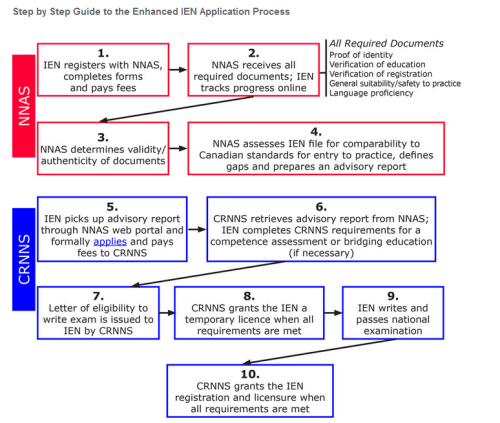
If you read the post CRNBC: New application process for Internationally Educated Nurses posted on Monday (2014), then you saw an excellent graphic explaining the licensure process to become an RN in BC. There I wrote about how the steps for NNAS are universal, but the steps for each provincial college is different. On Tuesday I wrote about the Criteria for Registration and Licensure for IENs in Nova Scotia. In this post it is clearly evident that the provincial registration processes have been legislated by law: provincial not federal law. Today I will be sharing the Enhanced IEN Application Process from CRNNS in Nova Scotia. The CRNNS, like the CRNBC, has provided a graphic that transparently outlines the process of becoming a nurse in Nova Scotia.
Compare and contrast these two documents (for BC and Nova Scotia), using critical thinking skills, to determine what are the similarities and what are the differences. And comment about them. Then consider, how does this information influence your decision about which provincial college you want to apply to, to become an RN.
Remember, this information is from 2014, when the process was originally being explained. Links were provided, but websites change over time, and this information is no longer accessible in this format on their site.
Kim
Enhanced IEN Application Process
Starting on August 12, 2014, all new internationally educated nurse (IEN) applicants in Canada must apply to the National Nursing Assessment Service (NNAS) prior to applying to the College. This requires you to send your documents and credentials toNNAS to be verified first before applying to the College. After you apply to the College, we will process your application for registration and licensure.What does this change mean to me, an internationally educated nurse applicant?
- You will be required to pay two separate fees, one to NNAS and one to the College. The NNAS fee is posted on the NNAS webpage;
- Streamlined online application process and an enhanced user friendly experience;
- Access to a 1-800 customer care telephone number;
- The ability to track the status of your application online at any time;
- More timely assessment of registration and licensure eligibility;
- You can use the nationally accepted NNAS advisory report, which is a comparison of your nursing program to a Canadian nursing program, to apply for registration and licensure to any registered nursing regulatory body in Canada (excluding Quebec and the territories). Your advisory report can also be used if applying to more than one category of nursing (i.e. RN, LPN and RPN).
Outlined Steps
Below is the guide that outlines the steps in the new IEN assessment process. NNAS is responsible for facilitating steps 1-4 as indicated by the red boxes and as the regulator, we (CRNNS) are responsible for facilitating steps 5-10 as indicated by the blue boxes.
Click to enlarge.
Save time and Money. Explore CELBANPrep University.





























 Dear Kim
Leave a comment