Updated 2024 (More than 1,000 people have learned from this post!)

Dear Aspiring Internationally Educated Health Professional,
Imagine you’re a healthcare professional in a bustling clinic. It’s June 10, 2021, at 10 am. Sara, a 14-year-old girl diagnosed with juvenile diabetes, walks in accompanied by her worried mother. She’s experiencing dizziness and fatigue. This scenario isn’t just a routine clinical visit; it’s a window into the intricate world of medical collocations, a crucial aspect for any Internationally Educated Health Professional (IEHP).
Unlocking the Mystery of Medical Collocations: A Real-Life Example
The Puzzle: Correcting Collocations in Everyday Clinical Encounters
Take a moment and ponder over this sentence: “She complained of dizziness and feeling of fatigue.” Does it sound right to you? If you think it does, that’s understandable. Many of us, especially non-native English speakers, unknowingly make errors in collocations – the art of word pairing in a language.
Why Collocations Matter in Healthcare Communication
Collocations are the unsung heroes of fluent and accurate communication. Before the digital era, understanding collocations was like grasping at straws – intuitive for native speakers but elusive for learners. They’re not governed by grammar rules but by usage patterns. For IEHPs, mastering medical collocations isn’t just about linguistic accuracy; it’s about building trust and clarity in every patient interaction.
Identifying and Correcting Common Collocation Errors
Let’s revisit our example: “She complained of dizziness and feeling of fatigue.” Here’s where we need to fine-tune:
- “Dizziness” is a noun, as is “fatigue.”
- “Dizzy” and “tired” are adjectives.
So, the correct collocations could be:
- “Dizziness and fatigue”
- “Dizziness and tiredness”
- “Feeling dizzy and tired”
Incorrect versions would be “dizziness and tired” or “dizzy and tiredness.” Why? Because aligning nouns with nouns and adjectives with adjectives is key to clear communication.
Your Pathway to Mastering Medical Collocations
Start with one medical collocation a day. It’s a manageable yet effective approach.
With one collocation a day, you’ll master 30 in a month, 90 in three months, and an impressive 365 in a year.
This consistent effort can significantly enhance your communication skills, making you not only a competent healthcare professional but also a relatable one.
Embarking on a Journey of Linguistic Excellence
Remember, every patient interaction is an opportunity to refine your skills. By dedicating yourself to mastering medical collocations, you’re not just improving your language abilities; you’re elevating the quality of care you provide. Embrace this journey of learning, and watch as your confidence and competence in the Canadian healthcare system flourish.
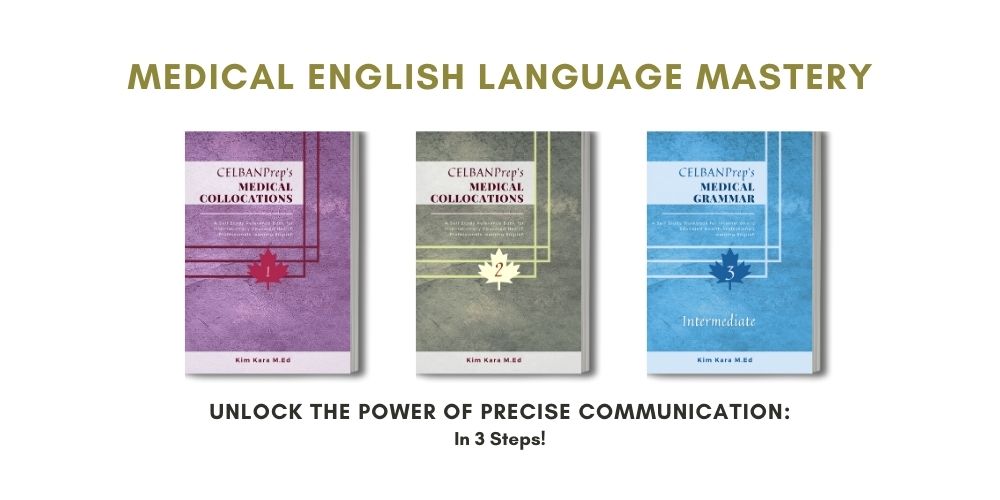
And that is why I dedicated over ten years to creating two dictionaries, filled with activating activities, on Medical Collocations! That you may flourish with confidence and competence in the Canadian healthcare system!
Warmest regards,
Kim

Find the English Mastery for Health Professionals and CELBAN Preparation paperbacks and e-books in various global Amazon stores:
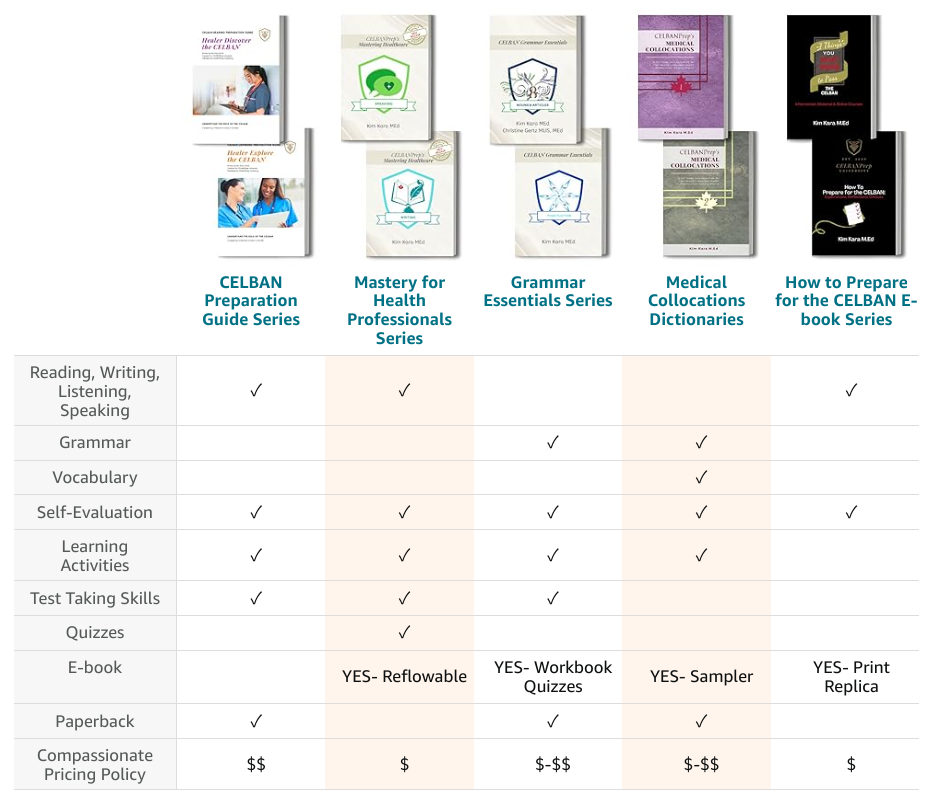
E-Books are available at these Amazon Marketplaces: (Many are FREE with Kindle Unlimited.)
US UK BR DE ES FR IN IT JP NL MX PL SE AU CA
Paperback books are available at the following Amazon Marketplaces:
US UK DE ES FR IT JP MX NL PL SE AU CA





























 Dear Kim
Leave a comment